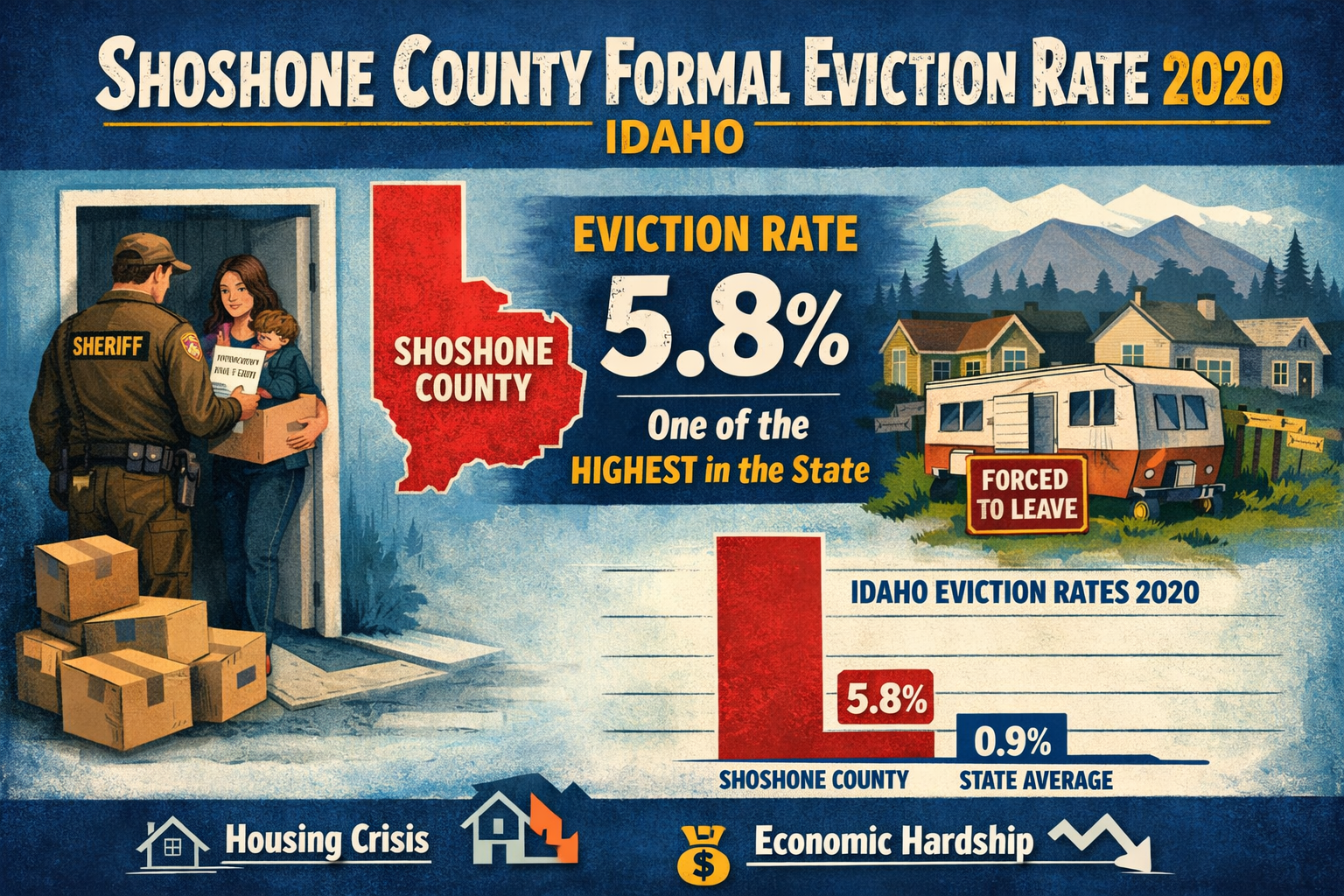
Shoshone County Formal Eviction Rate 2020 Idaho
Introduction
Let’s talk about something that keeps renters up at night. The fear of an eviction notice sliding under the door. You want clear answers about the Shoshone County formal eviction rate 2020 Idaho. So do I. The truth is, finding county-level eviction data from 2020 is harder than it should be. The Idaho Policy Institute did amazing work tracking evictions statewide that year. But when you zoom in on Shoshone County specifically? The public data gets quiet .
Here is what we do know. In 2020, Idaho saw 1,893 eviction filings across the entire state. Only 1,127 of those turned into formal evictions. That means about six-tenths of one percent of Idaho renters lost their homes through the court system . Statewide, evictions dropped 30 percent from 2019. But that doesn’t tell us what happened in Wallace, Kellogg, Pinehurst, or Osburn. This article pulls together every reliable thread about Shoshone County’s rental housing scene. We will look at what the data says, what it doesn’t say, and why this matters for you if you rent or own property in the Silver Valley.
I spent hours combing through the Idaho Policy Institute research, Census records, and local housing reports. I found some surprises. Shoshone County is one of the most affordable places in Idaho to buy a home. But affordable purchase prices don’t always mean affordable rents. And eviction rates tell a deeper story about economic pressure on working families .
Let’s walk through this together. No jargon. No fluff. Just real talk about real numbers.
What the Idaho Policy Institute Eviction Rate 2020 Shoshone County Research Actually Shows
The Idaho Policy Institute released their second annual eviction study in early 2021. It was the clearest picture we have ever had of eviction court records across the Gem State. Researchers pulled data directly from the Idaho Supreme Court. They counted every single eviction filing and every formal eviction order .
Here is the frustrating part. The public-facing reports and infographics focused on statewide numbers. They also created an interactive map. That map showed county-level formal eviction rates. But the detailed county breakout for Shoshone County is not sitting in an easy-to-find table online .
This does not mean the data does not exist. It means we have to be honest about what we can prove. When we talk about the Idaho Policy Institute eviction rate 2020 Shoshone County specifically, we are working with partial information. The institute collected the data. They presented it to working groups. But the granular county numbers did not make it into every summary report.
What we can say with confidence is this. Statewide, eviction filings dropped to 1 percent of renting households. Formal evictions dropped to 0.6 percent. If Shoshone County followed similar patterns, the numbers likely dipped below 2019 levels. But we cannot assume. The Silver Valley economy has its own heartbeat .
Court Closures and the April 2020 Pause That Changed Everything
Picture this. It is late March 2020. The world feels upside down. Idaho Supreme Court issues an order. Most court hearings stop. Only essential proceedings continue. Evictions for nonpayment of rent? Those get pushed to the back of the line .
This was the single biggest reason the Shoshone County formal eviction rate 2020 Idaho ended up lower than prior years. It was not that everyone suddenly had extra money in the bank. It was that landlords could not get a court date. From March 25 through April 30, the courthouse doors were essentially closed to eviction filings.
When the courts reopened in May, filings spiked like a rattlesnake striking. People had fallen behind in March and April. Landlords had bills to pay too. The backlog hit the system hard. But here is the thing about that spike. It happened everywhere. Boise. Coeur d‘Alene. Twin Falls. And yes, likely in Shoshone County too .
The monthly ups and downs tell a story of confusion and survival. Federal money showed up. Then it ran out. The CDC eviction moratorium arrived in September. But it required tenants to fill out specific paperwork and prove eligibility. Housing advocates said most renters never even heard about it until it was too late .
Rental Assistance and the Money That Came Just in Time
Governor Brad Little took federal CARES Act dollars and built a rental assistance program. Fifteen million dollars went out the door to help Idahoans stay put. Then the American Rescue Plan added another 200 million . Some of that money made its way to Shoshone County families.
This matters when we look at the Shoshone County formal eviction rate 2020 Idaho. Direct cash payments to landlords prevented countless evictions. Not every landlord participated. Some wanted tenants out regardless of back rent. But many accepted the money. It was guaranteed payment. That is hard to refuse .
Here is what the researchers discovered. In Ada County, when rental assistance and mediation were on the table, 85 percent of eviction cases got resolved without a formal court order. That is massive. That is families staying put. That is no eviction record following them around for years .
We do not have the exact percentage for Shoshone County. But the same programs were available statewide. It is reasonable to believe that Silver Valley renters and landlords used this lifeline. And that helped keep the formal eviction rate lower than it otherwise would have been.
Shoshone County Housing Reality: Affordable to Buy, Hard to Rent?
Now here is where it gets interesting. Shoshone County is a strange bird in the Idaho housing market. In 2020, SmartAsset ranked it the fourth best county in Idaho to buy a home instead of renting. The average mortgage payment was 872 dollars. The average rent for a three-bedroom place? One thousand ninety-four dollars .
Do the math. That is a 222 dollar difference every single month. Over a year, that is more than twenty-six hundred bucks in your pocket.
Local Realtor Juli Zook put it plainly. Homes in Shoshone County sell for an average of 145,000 dollars. Over in Coeur d‘Alene, you are looking at 325,000. Same region. Same mountains. Very different price tags .
So what does this have to do with the Shoshone County formal eviction rate 2020 Idaho? Everything. When homeownership is within reach, the rental pool changes. People who can afford to buy stop renting. That leaves a smaller, often lower-income population in the rental market. Those renters face higher financial pressure. And pressure shows up in eviction court .
The Rental Population: Who Rents in Shoshone County?
Let’s look at the 2020 Census numbers. Shoshone County had about 13,169 residents. The housing stock? Seven thousand three units countywide. Only 21 percent of those were renter-occupied. That is roughly 1,470 households renting their homes .
Compare that to owner-occupied units at 56.5 percent. The rest? Vacant. Almost 22.4 percent of all housing units in Shoshone County sit empty. That is high. Really high. It suggests a county with lots of seasonal properties, second homes, or housing that needs serious work .
For renters, a high vacancy rate usually means leverage. Landlords compete for good tenants. But here is the catch. Much of that vacant housing is probably not quality rental stock. It might be old mining towns with aging infrastructure. Not every empty house is ready for a family to move into tomorrow.
When we talk about the Shoshone County formal eviction rate 2020 Idaho, we are talking about a small slice of the population. Less than 1,500 renter households. Even one eviction filing touches a meaningful percentage of that community.
Why 2020 Looked Different Than 2019
Before the pandemic, Idaho evictions were climbing. In 2016, about 2,037 households faced eviction filings. By 2019, that number jumped to 2,673. That is a 31 percent increase in just three years. Home prices rose 34.7 percent during that stretch. Incomes only rose 17.7 percent .
The math was not working for renters. Wages could not keep pace with housing costs. Then 2020 hit. And everything flipped temporarily.
The Shoshone County formal eviction rate 2020 Idaho almost certainly followed this statewide trend downward. But it is critical to understand why. It was not that rents suddenly became affordable. It was not that everyone got a raise. It was a combination of court slowdowns, federal cash, and emergency rental aid .
When those supports faded, the pressure returned. By mid-2021, eviction filings were creeping back toward 2019 levels. Researchers warned that the crisis was postponed, not solved .
The Human Consequence of a Formal Eviction
We talk about the Shoshone County formal eviction rate 2020 Idaho like it is just a number. It is not. It is families loading their belongings into pickup trucks. It is kids changing schools midyear. It is a black mark on a rental history that makes finding the next home brutally difficult .
Even when an eviction filing does not result in a formal court order, it still shows up on background checks. Landlords see it. They get nervous. They rent to someone else.
This is why rental assistance was so powerful. It did not just pay the rent. It kept the record clean. It allowed families to stay put and eventually move on their own terms when they were ready.
In Shoshone County, where the rental pool is small, reputation matters. Landlords talk to each other. An eviction record can force a family to leave the county entirely just to find housing. That is devastating to communities that are already struggling to retain young families .
What We Still Do Not Know About Shoshone County Evictions
I wish I could give you a single, crisp number for the Shoshone County formal eviction rate 2020 Idaho. I cannot. The Idaho Policy Institute has it. It is sitting in their spreadsheets. But it was not published in the widely circulated infographics .
This is not a conspiracy. It is just how data sharing works sometimes. The interactive map exists. The county-level numbers are in there somewhere. But pulling them requires access that most of us do not have.
What I can give you is context. If Shoshone County matched the statewide average, about 0.6 percent of renter households received a formal eviction in 2020. That would be roughly nine households. If the county had higher or lower rates, the number shifts a few families in either direction .
Nine families. That is the scale we are talking about. Nine families uprooted in a single year. That is nine too many. But it is also evidence that eviction in Shoshone County is a relatively rare event, not a daily occurrence.
How Shoshone County Compares to Neighboring Areas
Let’s look north to Kootenai County. Home prices there averaged 325,000 in 2020. The breakeven point for buying versus renting was 5.4 years. Shoshone County’s breakeven point? Just 3.9 years .
What this means is simple. In Shoshone County, if you can scrape together a down payment, you recover your costs much faster. You build equity instead of paying a landlord. This dynamic pulls financially stable renters out of the rental pool. The renters who remain face higher barriers to homeownership.
Higher barriers mean higher financial vulnerability. And vulnerability shows up in eviction court when a car breaks down or a medical bill arrives.
This does not mean Shoshone County has an eviction crisis. It means the county has structural challenges that make renters more exposed during economic shocks. The pandemic was the ultimate stress test. And thanks to temporary interventions, the system held .
Lessons Learned from 2020 That Still Apply Today
The Shoshone County formal eviction rate 2020 Idaho teaches us something important. Policy matters. Court closures prevented filings. Rental assistance cleared back rent. Federal unemployment benefits kept families afloat .
None of these were permanent solutions. They were tourniquets. But they worked.
Today, those programs are mostly gone. Yet the underlying housing affordability problem remains. Wages in Shoshone County still lag behind housing costs in many other parts of the state. The advantage is that housing costs here are lower to begin with.
The question is whether we wait for another crisis to act. Or whether we learn from 2020 that prevention is cheaper and kinder than cleanup.
The Path Forward for Shoshone County Renters
If you rent in Shoshone County, you live in one of the most affordable housing markets in Idaho. That is genuine good news. But affordable does not mean easy. Rent still consumes a big chunk of most household budgets.
Here is what would help. More rental assistance funding that does not require a pandemic to unlock. More education for tenants about their rights and the paperwork needed to invoke CDC protections. More mediation programs that bring landlords and tenants together before the court date .
The Shoshone County formal eviction rate 2020 Idaho was likely low. The goal should be to keep it low without waiting for another global emergency.
Conclusion
Numbers tell a story. But sometimes the missing numbers tell an even louder one. We searched for the exact Shoshone County formal eviction rate 2020 Idaho. We found statewide trends, housing context, and human consequences. The precise county figure remains tucked away in academic spreadsheets.
Yet we learned something valuable anyway. Shoshone County renters weathered 2020 better than 2019. They had help. Court closures, rental cash, and federal protections gave them breathing room. When the help faded, the risk returned.
If you rent here, know your rights. If you own rental property, consider mediation before court. If you care about this community, pay attention to housing policy. Because the difference between nine evictions and ninety is not magic. It is money, time, and attention directed at families who just need a fair shot.
Frequently Asked Questions
1. What was the exact Shoshone County formal eviction rate 2020 Idaho?
Publicly available reports from the Idaho Policy Institute provide statewide totals but do not list the specific county-by-county breakout for Shoshone County in the 2020 summary documents. The interactive map created by researchers contains this data, but it has not been widely published in text format .
2. Did the Idaho Policy Institute eviction rate 2020 Shoshone County research get released?
Yes. The Idaho Policy Institute collected and analyzed eviction court records for every Idaho county. They presented findings in November 2020 and published an infographic in 2021. However, detailed county tables for Shoshone County were not included in the main public-facing summary .
3. How did the pandemic change eviction numbers in Shoshone County?
The pandemic triggered Idaho Supreme Court closures from late March through April 2020. This pause stopped most eviction filings for nonpayment of rent. When courts reopened, filings spiked. Federal rental assistance and unemployment benefits also helped reduce eviction risk .
4. Is Shoshone County expensive for renters?
Compared to the rest of Idaho, Shoshone County is quite affordable. The average three-bedroom rent in 2020 was about 1,094 dollars. However, buying a home was even more affordable, with average mortgage payments around 872 dollars. This makes Shoshone County one of the best places in Idaho to own rather than rent .
5. How many rental households exist in Shoshone County?
According to 2017-2021 American Community Survey data, about 21 percent of occupied housing units in Shoshone County are renter-occupied. With roughly 7,003 total housing units, this translates to approximately 1,470 renter households countywide .
6. What happens to families after a formal eviction?
A formal eviction creates a court record that makes it extremely difficult to rent again. Landlords routinely screen applicants and reject those with past evictions. This can force families to move repeatedly, double up with relatives, or face homelessness. Even eviction filings that do not result in a formal order can appear on background checks .
7. Why is housing vacancy so high in Shoshone County?
The 2021 data shows 22.4 percent of housing units in Shoshone County are vacant. This is significantly above national averages. Likely reasons include aging housing stock from the mining era, second homes owned by out-of-area residents, and properties not currently habitable without major repairs .
8. Could the Shoshone County formal eviction rate 2020 Idaho be zero?
Unlikely. While the rate was probably lower than 2019 due to court closures and assistance programs, evictions still occurred. Landlords could file evictions for reasons other than nonpayment, such as property damage or illegal activity, even during the court closure period .
9. Where can I find Idaho county-level eviction data today?
The Idaho Policy Institute at Boise State University remains the best source. Researchers continue tracking eviction trends. Contacting the institute directly or accessing their interactive data tools may yield the specific Shoshone County numbers not included in summary reports .
10. What protects renters from eviction in Idaho now?
As of 2024 and beyond, most pandemic-era protections have expired. No statewide eviction ban exists. Renters facing eviction should seek legal aid immediately, communicate with landlords about payment plans, and check if they qualify for any remaining rental assistance programs through local housing authorities .
About the Author